
News
January 2026:
I began painting in 2021. I am self-taught with no formal training. A little over fours year later, I am deeply honoured to have been offered a place on the MA Painting course at The Royal College of Art. I will be starting in September 2026.
Collectors who buy my work help me to continue painting and support the cost of my studies. If you are unable to purchase a painting, please consider giving a donation of your choice here. I have a target of £17,350 fees to raise. (I do not qualify for a post graduate loan because I am over the age limit).
Thank you.
Exhibitions
2026
Materiality, Espacio Gallery, London, 29 Jan-02 Feb
Islington Art Society, Spring Exhibition, London, 15-26 April
2025
Open Studio, London, 27 April
Emerging, ART@111 Gallery, London, 9-14 December
The exhibition title ‘Emerging’ comes from my interest in the ideas that emerge when looking at the completed work.
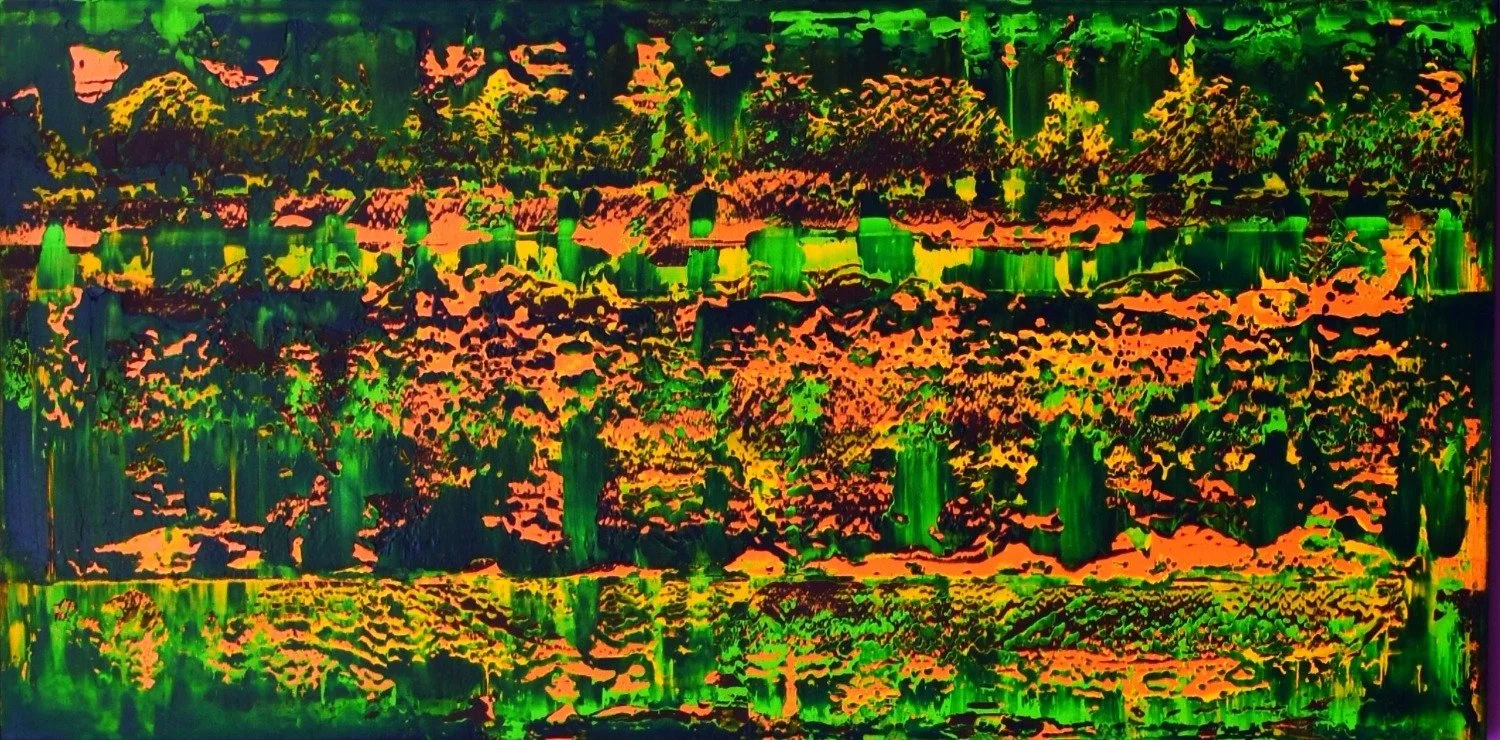
Serengeti, 2025
Painting with Entropy: A Scientist’s Approach to Abstraction
A conversation with John David Begg,
by Emily Edgar.
”The function of the artist is to bring imagination to science and science to imagination, where they meet, in the myth.”
— Cyril Connolly“
John David Begg’s upcoming solo show at the Art@111 gallery, Emerging, offers a captivating glimpse into how a scientific mind engages with the inherently unpredictable world of art.
“It feels strange sometimes,” he tells me, “because in the art world people often like to have a concept prepared beforehand. I tend to work in reverse: I make the painting first, and the title comes afterwards.” The titles, he explains, are drawn from the sciences, politics, or social observations - areas he has long professionally explored intellectually and academically. In fact, my personal favourite, for example, First Light, evokes the cosmological moment after the Big Bang when photons finally travelled freely across the universe. To Begg, painting is a form of communication, not simply a visual exercise, and he delights in how viewers’ interpretations often shift and expand the meaning of his work. The artist explained, “I am trying to explore communication; the relationship between me and the viewer, and how meaning forms.” It is a struggle, he admits, but one that is central to his journey and practice. “It’s all about communication and the fact that meaning is never complete or fixed. We all interpret things differently.”
He asked me what I thought of a particularly striking painting of vivid oranges and greens, later revealed to be titled Serengeti. To me, I saw the fiery intensity of flames in the orange and cool, ethereal ripples of the aurora borealis in the green. While these are natural phenomena, I couldn’t help but notice the underlying scientific patterns at play - a microcosm perhaps of the wonderful interplay of nature and science that runs throughout Begg’s work.
I of course found his approach very compelling - the contrast between his scientific background and this very fluid, natural style of working. Begg’s practice oscillates between two styles: liquid and linear. The liquid pieces, which dominate his recent works, embrace the chaotic beauty of entropy. He describes entropy not just as a scientific principle but as an essential creative tool: “The disorder comes from the way I apply the paint. You can never fully predict the outcome.” Using palette knives, squeegees, brushes, and sponges, he applies multiple layers of acrylic, often experimenting with both texture and mediums. Colour, he admits, is also sometimes a surprise - unexpected green patches emerging from interactions between wet and dry layers. He celebrates unpredictability— the accidental green here, the unintended texture there, and very poignantly describes it as “Part of the magic of it all.”
Everything is an experiment,” he says. “Even early on, when I used house paint and canvases found on the street, I was learning through trial and error.”
Throughout our meeting in his London studio that he built himself, I was struck by the rare union of analytical mind and painterly intuition - a dialogue between order and disorder, science and art, structure and spontaneity. As Cyril Connolly wrote, the artist brings imagination to science and science to imagination and in Begg’s work, this notion is unmistakable. Each piece invites the viewer into a dialogue with both nature and process, where meaning emerges, just as the artworks do in a beautiful display of entropy.
Emerging, Art@111, December 2025